Monika Pis, PhD, CPNP
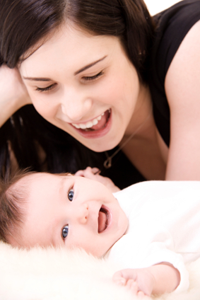
Language development is intricately woven together with cognitive development. Often an infant’s gestures are a part of their emerging language. For example, a 1-year-old may point to a bottle of juice and grunt, letting her parent know that she wants it. Symbolic gestures at 13 months are highly correlated with future language ability. Children who have a rich gesture communication system in toddlerhood are likely to develop normal linguistic skills even if they are late bloomers.
The acquisition of new words between 12 to 18 months is slow. By 18 months of age, a toddler should say at least 5 words and understand more than 50.
2-year-olds start to show an understanding of the rules of language by putting words together. At this age the child produces more than 50 words, follows 2-step commands, points to objects and names them, and uses words to request things. She also develops new words daily, and may get confused if adults talk to her like a baby.
Receptive language is always ahead of expressive language, thus children will always understand more than what they are able to say. This usually results in moderate frustration due to inability to express feelings and desires, and temper tantrums might emerge. To prevent these kinds of temper tantrums, read to your child daily from birth. Reading together is a quality family time, and studies show that by making a habit of it, you will assist your child in early language acquisition.
Showing posts with label Development. Show all posts
Saturday, February 2, 2013
Friday, February 1, 2013
Developmental Milestones: Birth to 6 Months
Monika Pis, PhD, CPNP
Babies develop at all different rates but here's what to look for from newborn to 6 months of age.
Newborn to 2 months
The first two months of your baby’s life is a time of adjustment into her new environment. She will learn new sounds and become comfortable with her surroundings. This period is also the time for new parents to get to know their newborn.
From the very first days, your newborn knows how to communicate with her bodily movements, facial expressions, and sounds. Observe and listen to her carefully and in a very short time, you’ll be able to distinguish a hungry, tired or bored cry. Also, you’ll know when your baby needs a break from what she is doing because she will look away, arch her back, frown, or cry.
In the first two months of life, mutual gaze is a powerful form of socialization. Let you baby watch your face and exchange looks. Show your infant a colorful toy and slowly move it from side to side, allowing her gaze to follow the toy. Interaction with your baby will strengthen your bond, as well as help strengthen the eye muscles.
Newborn to 2 months
The first two months of your baby’s life is a time of adjustment into her new environment. She will learn new sounds and become comfortable with her surroundings. This period is also the time for new parents to get to know their newborn.
From the very first days, your newborn knows how to communicate with her bodily movements, facial expressions, and sounds. Observe and listen to her carefully and in a very short time, you’ll be able to distinguish a hungry, tired or bored cry. Also, you’ll know when your baby needs a break from what she is doing because she will look away, arch her back, frown, or cry.
In the first two months of life, mutual gaze is a powerful form of socialization. Let you baby watch your face and exchange looks. Show your infant a colorful toy and slowly move it from side to side, allowing her gaze to follow the toy. Interaction with your baby will strengthen your bond, as well as help strengthen the eye muscles.
Studies show that reading to you infant from a very young age allows for early acquisition of language skills. Therefore, spend a few minutes every day reading to your baby. You can also talk to her about your day and even sing--it makes for good family time and above all, your baby will love to listen to your voice!·
Milestones you should look for:
1-2 weeks:
- Responds to noise
- Looks at your face
- Tries to lift head when placed on the belly
- Responds to noise
- Looks at your face
- Tries to lift head when placed on the belly
2 months:
- Responds to noise
- Makes baby sounds
- Smiles back at you
- Follows people with her eyes
- Holds head up 45 degrees when placed on the belly
- Responds to noise
- Makes baby sounds
- Smiles back at you
- Follows people with her eyes
- Holds head up 45 degrees when placed on the belly
Things to do to enhance your baby's development:
- Read daily to your baby
- Observe to learn your baby's needs
- Respond to cries. It teaches your baby trust and that she is loved.
- Read daily to your baby
- Observe to learn your baby's needs
- Respond to cries. It teaches your baby trust and that she is loved.
Age 2-6 months
Infants between 2 and 6 months of age are very interactive. They love to imitate anything that helps them learn new skills. For example, if mom sticks her tongue out, baby will usually do the same. This game teaches the infant the art of communication. Babies this age love to discover their voices, so you may hear your baby coo or babble frequently. As she coos and babbles, talk and babble back to her, as if you both understand each other very well. This exercise also teaches your baby how to communicate and, at the same time, lays groundwork for developing extensive vocabulary later on.
At about 3-4 months of age, babies start to laugh out loud, they can sit with support, and grasp a rattle. Soon, at about 6 months of age, they’ll be reaching out for objects. Since infants learn by looking at, holding, and putting objects into their mouths, keep all small objects out of your baby’s reach. It’s good to remember the toilet paper roll rule: objects that can fit through a toilet paper tube, including plastic bags and deflated balloons, are too small for children younger than 3 years.
Closer to 5-6 months, babies start to have a better control over their bodies. They will be able to roll over, pull up to sit without a head lag, and transfer objects from hand to hand.
At about 3-4 months of age, babies start to laugh out loud, they can sit with support, and grasp a rattle. Soon, at about 6 months of age, they’ll be reaching out for objects. Since infants learn by looking at, holding, and putting objects into their mouths, keep all small objects out of your baby’s reach. It’s good to remember the toilet paper roll rule: objects that can fit through a toilet paper tube, including plastic bags and deflated balloons, are too small for children younger than 3 years.
Closer to 5-6 months, babies start to have a better control over their bodies. They will be able to roll over, pull up to sit without a head lag, and transfer objects from hand to hand.
Milestones to you should look for:
4 months:
- Rolls over
- Sits with support (keeps head steady)
- Grasps a rattleLaughs out loud
- Holds head up 90 degrees when placed on the belly
- Looks around 180 degrees
- Rolls over
- Sits with support (keeps head steady)
- Grasps a rattleLaughs out loud
- Holds head up 90 degrees when placed on the belly
- Looks around 180 degrees
6 months:
- Reaches for objects
- Transfers objects form hand to hand
- Bears weight on legs when standing up with support
- Reaches for objects
- Transfers objects form hand to hand
- Bears weight on legs when standing up with support
Things to do to enhance your baby’s development:
- Talk and babble with your baby back and forth
- Read daily
- Lay baby on back and hold brightly colored toy over her chest to promote reaching
- Introduce one toy at the time to allow for exploration
- Talk and babble with your baby back and forth
- Read daily
- Lay baby on back and hold brightly colored toy over her chest to promote reaching
- Introduce one toy at the time to allow for exploration
Thursday, January 31, 2013
Language Milestones: Birth to 6 Months
Monika Pis, PhD, CPNP
Developing language skills and the growth of cognitive abilities allow children to interact with the surrounding world.
Language development begins before birth as the baby perceives the sounds of the womb. There is evidence that the baby possesses receptive language ability well before birth. She can hear and respond to environmental sounds and start to develop memories of them.
Expressive language development also begins early. Cooing, which is when the baby produces vowel sounds, begins in the first two months of life. Increased volume in cooing begins to develop around one month of age, and pitch variability can be noticed between two and four months of age. During that time, when you converse with your infant, you should notice some variation in tone. These “conversations” are a great exercise that teaches your baby the art of conversing.
By six months of age infants should start to babble. The ability to babble requires coordination of muscles on the pharynx. When babbling begins these muscles get exercised, and your infant discovers her ability to talk. By nine months of age you should hear your baby say “mama" or "dada." Often “dada” is heard first, because the nasal sound “m” is harder to produce than the “d” sound. But don’t worry, she will say “mama” pretty soon--especially if you practice with her!
Between 9 and 12 months your baby will start to point to objects. This is a very important language milestone, as it proceeds the naming of objects. By the age of one year, a child usually has learned one other word besides “mama” and “dada” and is able to follow one-step commands.
| AGE Newborn: By 3 months: By 6 months: By 9 months: By 12 months: | LANGUAGE MILESTONES The baby turns to soft voices, especially the voices of his/her parents. The baby produces cooing sounds and smiles responsively. The baby turns to familiar sounds, laughs, and coos. The baby babbles "mamama," "bababa," and knows his/her name, and turns when called. The child has learned one word other than “mama” and “dada” and follows one-step commands. |
Subscribe to:
Posts (Atom)


